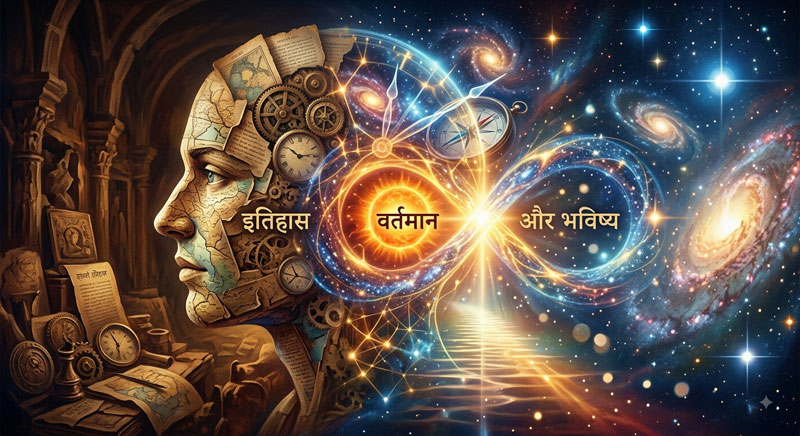
You can make a hell of heaven and a heaven of hell
The interplay of integrative and disintegrative forces is a fundamental principle governing every aspect of existence. Integrative forces promote unity, harmony, cooperation, stability, and growth. They bring individuals, families, organizations, and societies together, enabling them to function as coherent and resilient systems. In contrast, disintegrative forces generate fragmentation, conflict, disorder, decay, and eventual collapse. Left unchecked, they weaken relationships, institutions, and even the human personality by eroding trust, discipline, and shared purpose.
Human life unfolds amidst the continuous interaction of these opposing tendencies. Every thought we entertain, every decision we make, and every action we perform either strengthens integration or accelerates disintegration. Truthfulness builds trust, compassion nurtures relationships, discipline enhances character, and responsible conduct strengthens society. Conversely, dishonesty, selfishness, hatred, negligence, and indifference intensify division and disorder.
Conscious action is the decisive factor that determines which force prevails. Unlike inanimate objects, human beings possess awareness, reason, and the capacity to choose. By cultivating knowledge, ethical values, self-discipline, and continuous self-improvement, individuals consciously invest energy in preserving order and promoting constructive change. This sustained effort transforms entropy into organization and conflict into cooperation.
A meaningful and prosperous life, therefore, is not the result of chance but of consciously aligning our thoughts and actions with integrative forces that foster personal excellence, social harmony, and the long-term well-being of humanity.
In fact, every observable system in the universe undergoes continuous change. Material things, individuals, families, communities, governments, and nations do not remain stable automatically. Stability is never permanent; it is continuously created. Whenever attention, effort, discipline, or ethical responsibility diminishes, disorder gradually emerges. This disorder seldom appears suddenly. It grows silently through neglect, indifference, complacency, and failure to adapt. The opposite is equally true: wherever continuous investment of wisdom, ethics, discipline, and cooperation exists, order is preserved and progress becomes sustainable.
A neatly arranged room slowly becomes untidy. Dust accumulates on furniture. Iron rusts when exposed to moisture. A beautifully maintained garden gradually becomes overgrown with weeds if left unattended. A polished automobile loses its shine. None of these changes require conscious effort. They occur spontaneously as a consequence of natural physical processes. Restoring order, however, is entirely different. Cleaning a room requires labour. Removing rust requires chemical treatment and repainting. Maintaining a garden requires watering, pruning, fertilizing, and protecting plants from pests. Every act of restoration consumes time, energy, knowledge, planning, and resources. Nature effortlessly produces disorder; human intelligence consciously creates order.
Material systems provide the simplest demonstration of this principle. Every physical object is continuously exposed to environmental influences that gradually reduce its efficiency and structural integrity. Metals oxidize and corrode. Wood decays under moisture and biological attack. Plastics deteriorate under ultraviolet radiation. Concrete develops cracks through repeated cycles of expansion and contraction. Electronic components age because of thermal stress and material fatigue. Even mountains slowly erode under the combined action of wind, rain, rivers, glaciers, and earthquakes.
These processes are neither accidental nor exceptional. They represent the ordinary operation of natural laws. The tendency toward deterioration exists continuously, whether or not human beings observe it. Engineers recognize this reality through the philosophy of preventive maintenance. Buildings are painted before corrosion penetrates structural steel. Bridges undergo periodic inspections to identify microscopic cracks before they become dangerous. Pipelines are cleaned to prevent blockage and corrosion. Electrical wiring is replaced before insulation failure causes fire hazards. Roads are resurfaced before small cracks expand into large potholes.
None of these activities create permanent perfection. Instead, they continuously oppose the natural tendency toward deterioration. Maintenance therefore becomes not an unnecessary expense but an indispensable investment. Engineering economics repeatedly demonstrates that preventive maintenance is usually far less expensive than corrective maintenance. Replacing a worn bearing costs far less than rebuilding an entire damaged machine. Repairing small structural cracks prevents costly bridge failures. Servicing engines regularly extends their lifespan while reducing fuel consumption and unexpected breakdowns.
Preventive action is more economical than corrective action. Machines illustrate this principle even more clearly because they contain moving parts that constantly interact with one another. Every rotating shaft experiences friction. Bearings gradually wear. Lubricants lose viscosity through oxidation and contamination. Dust accumulates inside mechanisms. Vibrations loosen fasteners. Repeated heating and cooling produce material fatigue. Electrical contacts oxidize, reducing conductivity. Rubber seals harden with age. Springs lose elasticity after repeated loading.
They occur automatically whenever machines operate. Consequently, every machine eventually fails unless systematic maintenance is performed. Engineers therefore establish maintenance schedules based upon operating hours, environmental conditions, and expected component life. Lubricants are replaced before losing effectiveness. Filters are cleaned before restricting airflow. Worn components are replaced before failure damages surrounding equipment.
Maintenance engineers distinguish between reactive maintenance and preventive maintenance. Reactive maintenance waits until breakdown occurs before repairs begin. Although sometimes unavoidable, this approach often results in expensive downtime, emergency repairs, and production losses. Preventive maintenance, by contrast, intervenes before failure occurs. Components are inspected, cleaned, adjusted, lubricated, and replaced according to planned schedules. The objective is not merely repairing machines but preventing failures altogether.
Modern industry has advanced even further through predictive maintenance. Sensors continuously monitor vibration, temperature, pressure, acoustic signals, oil quality, and electrical characteristics. Artificial intelligence analyzes these measurements to detect early signs of deterioration. Maintenance is then scheduled precisely when required rather than according to fixed intervals.
This intelligent approach significantly reduces costs while maximizing reliability. Disorder cannot be eliminated, but its consequences can be anticipated and controlled through scientific management. Modern aviation provides one of the most impressive demonstrations of this philosophy. Commercial aircraft operate under extremely demanding conditions involving enormous mechanical stress, changing atmospheric pressures, temperature variations, and repeated take-off and landing cycles. Despite these challenges, air travel remains among the safest forms of transportation.
This remarkable safety record exists not because aircraft are immune to deterioration but because deterioration is expected, measured, documented, and corrected before it becomes hazardous. Every aircraft undergoes rigorous inspection schedules. Critical components are replaced after predetermined operating hours regardless of visible condition. Engines receive comprehensive examinations using advanced diagnostic technologies. Maintenance records are meticulously documented and independently verified.
The aviation industry therefore illustrates a profound lesson: the safest systems are not those that never deteriorate, but those whose deterioration is continuously monitored and managed. Factories represent an even higher level of organizational complexity because they consist not merely of machines but also of workers, management systems, information networks, supply chains, inventories, production schedules, quality control mechanisms, and financial operations. Each component interacts continuously with every other component.
Operational disorder within factories appears in numerous forms. Production bottlenecks reduce efficiency. Machine downtime interrupts workflow. Excessive inventories increase storage costs. Defective products waste materials. Poor communication creates confusion. Unsafe working conditions increase accidents. Energy inefficiency raises operating expenses. Inadequate planning delays deliveries.
Industrial engineering seeks to reduce such operational disorder through systematic organization. Standard operating procedures establish consistency. Quality management systems identify defects before products reach customers. Lean manufacturing eliminates unnecessary activities. Six Sigma methodologies reduce process variation. Automation improves precision. Continuous monitoring enables rapid correction of emerging problems. Efficiency does not arise spontaneously. It emerges only through disciplined coordination of countless interacting components.
The Japanese philosophy of Kaizen, meaning continuous improvement, perfectly illustrates this principle. Rather than waiting for major failures, organizations encourage workers at every level to identify small opportunities for improvement. Minor inefficiencies are corrected before they accumulate into major operational problems. Thousands of small improvements collectively produce remarkable long-term gains. Kaizen therefore represents an organized strategy for resisting operational disorder. Continuous improvement prevents gradual deterioration from becoming systemic failure.
Industries operating on national and global scales encounter disorder in even more complex forms. Supply chains become disrupted by geopolitical conflicts, natural disasters, or transportation failures. Technologies rapidly become obsolete. Skilled workers retire, taking valuable experience with them. Regulations evolve. Consumer preferences change. Environmental standards become stricter. Competitors introduce innovative products. Global markets fluctuate unpredictably. Organizations that assume yesterday’s success guarantees tomorrow’s prosperity gradually lose competitiveness.
History repeatedly confirms this observation. Numerous corporations once dominated global markets yet eventually disappeared because they failed to adapt. They underestimated technological change, ignored emerging customer needs, neglected research and development, or became complacent after prolonged success. Conversely, organizations that continuously invest in scientific research, employee education, technological modernization, organizational learning, and strategic adaptation remain competitive across generations.
Innovation itself may therefore be understood as humanity’s organized response to disorder. Every scientific discovery reorganizes knowledge. Every technological invention reorganizes resources into more efficient forms. Every managerial improvement reorganizes human effort. Innovation does not eliminate future challenges; rather, it temporarily creates higher levels of organization until new conditions require further adaptation.
Information systems provide another fascinating application of the concept of disorder. In information theory, introduced by Claude Shannon, disorder measures uncertainty or the amount of information associated with a message. Communication channels constantly face disturbances in the form of electrical noise, signal interference, transmission errors, and data corruption.
Engineers employ sophisticated methods to preserve informational order. Error-correcting codes detect and repair transmission mistakes. Data compression organizes information efficiently. Encryption protects confidentiality against unauthorized access. Redundant storage prevents data loss. Backup systems preserve information during hardware failures. Network monitoring continuously identifies emerging problems before they disrupt communication. Without these protective mechanisms, digital communication would rapidly become unreliable.
Cybersecurity represents another organized effort to resist informational disorder. Modern computer networks are constantly exposed to malware, ransomware, phishing attacks, software vulnerabilities, insider threats, and hardware failures. Cybercriminals continuously develop new methods of exploiting weaknesses, while defenders must continuously improve protective measures.
Regular software updates close security vulnerabilities. Firewalls filter malicious traffic. Multi-factor authentication strengthens identity verification. Security audits identify hidden weaknesses. Continuous monitoring detects suspicious behaviour before serious damage occurs. Disaster recovery plans ensure that critical information remains available even after unexpected failures. Information security therefore illustrates precisely the same universal principle: order survives only through continuous vigilance and maintenance.
The significance of informational organization extends far beyond computers. Modern civilization increasingly depends upon reliable information systems. Banking transactions, healthcare records, transportation networks, educational platforms, scientific research, industrial automation, emergency services, and governmental administration all rely upon accurate, secure, and continuously maintained digital infrastructure.
If informational disorder were allowed to grow unchecked, essential public services could become unreliable, economic activity would be disrupted, scientific collaboration would slow, and public confidence in digital systems would decline.
In the domain of life, friendship is not merely an emotional connection formed at one moment in life. It is a living relationship that requires continuous care. Two individuals may become close because of shared experiences, common interests, or mutual trust. Yet these initial foundations alone cannot guarantee that the friendship will endure indefinitely.
Friendships rarely collapse because one person deliberately decides to destroy them. More often, they weaken through gradual neglect. Communication becomes infrequent. Misunderstandings remain unresolved. Expectations are left unspoken. Appreciation diminishes. Small disappointments accumulate. Shared experiences become rare. Emotional distance slowly replaces emotional closeness.
Each neglected conversation slightly weakens mutual understanding. Every unresolved misunderstanding creates invisible barriers. Every broken promise reduces trust. Every failure to empathize increases emotional isolation. None of these individual events may appear significant, but together they steadily increase relational disorder.
Strong friendships therefore require continuous emotional investment. Honest communication prevents misunderstandings from accumulating. Mutual respect preserves dignity. Forgiveness removes emotional burdens before they become permanent resentments. Appreciation reminds individuals that they are valued. Shared experiences create new memories that strengthen emotional bonds. Reliability builds confidence that support will be available during difficult times.
Just as machines require lubrication to reduce friction, friendships require kindness to reduce emotional friction. Just as engineers inspect bridges before structural weaknesses become dangerous, friends must periodically renew trust before emotional distances become irreversible. Maintenance is not evidence of weakness. Rather, maintenance is the very condition of durability.
Families provide an even more important example because they represent the primary institution in which human personality develops. Every family is composed of individuals with different temperaments, ambitions, expectations, values, experiences, and emotional needs. Children grow into adults. Parents age. Careers change. Financial conditions fluctuate. Health challenges arise. Technology transforms communication. New generations develop different perspectives.
Such diversity naturally introduces complexity into family life. Complexity itself is not harmful. Problems emerge when complexity is ignored rather than managed. If family members stop communicating openly, misunderstandings multiply. If affection is no longer expressed, emotional distance increases. If responsibilities become unequal, resentment develops. If forgiveness disappears, old conflicts continue to influence present relationships. If appreciation is absent, individuals begin to feel neglected despite living under the same roof.
Eventually, relationships may deteriorate without any single catastrophic event. The breakdown occurs because numerous small failures accumulate over many years. The family gradually loses its internal organization. Healthy families therefore invest continuously in emotional maintenance. Regular conversations create mutual understanding. Shared meals strengthen daily connections. Family traditions preserve identity across generations. Celebrations reinforce belonging. Mutual respect protects individual dignity. Shared responsibilities promote fairness. Collective decision-making develops cooperation. Ethical values provide guidance during uncertainty. Compassion enables members to support one another during illness, financial hardship, or emotional distress.
Importantly, family harmony does not require the absence of disagreement. Differences of opinion are natural wherever independent minds exist. True harmony lies in resolving disagreements constructively before they accumulate into lasting bitterness. Conflict management, not conflict avoidance, preserves family organization.
Communities and societies operate according to exactly the same principle but on a much larger scale. Every society consists of enormous diversity. People differ in language, religion, culture, profession, education, economic status, political beliefs, and personal aspirations. Diversity should never be confused with disorder. Indeed, biological ecosystems demonstrate that diversity often enhances resilience. Human societies similarly benefit from multiple perspectives, skills, and traditions.
Disorder arises not because diversity exists but because institutions fail to manage diversity fairly and constructively. Social disorder appears gradually through corruption, declining public trust, misinformation, crime, discrimination, inequality, political polarization, weakening civic responsibility, and erosion of shared ethical standards. None of these developments emerge overnight. They accumulate over years whenever institutions become inefficient or citizens neglect their responsibilities.
When people lose confidence in public institutions, cooperation declines. When corruption becomes normalized, honesty loses its social value. When misinformation replaces evidence, rational decision-making becomes increasingly difficult. When justice becomes selective, citizens begin doubting the legitimacy of governance itself. These developments resemble cracks appearing in a building. Each crack may appear insignificant initially, yet together they gradually threaten structural stability.
Strong societies therefore invest continuously in institutional maintenance. Education develops informed citizens capable of rational participation. Public health preserves human productivity. Scientific research generates innovation. Infrastructure supports economic activity. Independent journalism encourages accountability. Transparent governance strengthens public trust. Civic participation enables peaceful correction of governmental failures.
These institutions function collectively as mechanisms that reduce social disorder while preserving individual freedom. They require constant improvement because society itself never stops changing.
Among all institutions, the justice system illustrates this principle with exceptional clarity. Laws alone cannot guarantee order. A legal code printed in books possesses no independent power. Justice emerges only when laws are applied fairly, consistently, and transparently. Independent courts ensure impartial interpretation of law. Honest policing protects citizens without abusing authority. Efficient investigations prevent criminal impunity. Timely judicial decisions preserve public confidence. Equal treatment before the law reinforces social legitimacy.
Whenever these mechanisms weaken, legal systems themselves become vulnerable to disorder. Delayed justice encourages frustration. Selective enforcement encourages discrimination. Political interference reduces institutional independence. Corruption undermines credibility. Eventually citizens begin relying upon personal influence rather than legal processes. The deterioration again occurs gradually. Institutional disorder accumulates through repeated neglect rather than sudden collapse.
Economic systems provide another powerful illustration. Every economy continuously faces changing circumstances. Inflation reduces purchasing power. Financial fraud weakens confidence. Resource depletion challenges production. Technological innovation transforms employment. Global competition alters industrial priorities. Environmental pressures require sustainable development. Demographic changes modify labor markets. International conflicts disrupt supply chains.
Economic stability therefore cannot be preserved simply because prosperity once existed. History repeatedly demonstrates that nations enjoying extraordinary wealth eventually encounter stagnation if they stop innovating. Likewise, countries once considered economically weak may achieve remarkable growth through education, entrepreneurship, technological adaptation, institutional reforms, and responsible governance.
Successful economies continuously invest in human capital. Schools educate future workers. Universities expand knowledge. Research institutions create innovation. Entrepreneurs develop new industries. Transparent regulations encourage fair competition. Stable monetary policy controls inflation. Responsible fiscal management preserves long-term financial confidence. Economic order is therefore never permanent. It must be renewed continuously through intelligent adaptation.
The same principle applies within organizations and workplaces. Companies do not fail only because competitors become stronger. Many fail because internal systems gradually lose efficiency. Communication becomes fragmented. Innovation slows. Employee motivation declines. Leadership becomes complacent. Customer expectations change while organizational practices remain outdated.
Successful organizations therefore establish cultures of continuous improvement. Training upgrades professional skills. Performance evaluation identifies weaknesses early. Ethical leadership builds trust. Open communication encourages creativity. Technological modernization improves productivity. Strategic planning prepares organizations for future uncertainties.
Continuous learning becomes the organizational equivalent of preventive maintenance. Education itself illustrates the universal necessity of continuous investment. Knowledge is never permanently acquired. Human understanding expands continuously. Scientific discoveries modify previous theories. New technologies create new professions. Social conditions evolve. Ethical challenges become increasingly complex.
Individuals who stop learning gradually become less capable of understanding contemporary reality. Their knowledge becomes outdated not because it was incorrect originally but because the world continued changing while they remained intellectually stationary.
Lifelong learning therefore represents continuous investment against intellectual disorder. Reading, observation, dialogue, research, critical thinking, and openness to evidence preserve mental organization. Curiosity prevents intellectual stagnation. Humility enables correction of mistakes. Education thus becomes not merely preparation for life but an ongoing process throughout life itself.
Human character also follows this universal law. Integrity cannot be established once and then permanently preserved without effort. Compassion requires repeated practice. Patience develops through repeated self-control. Courage grows through repeated ethical choices. Honesty survives only when individuals consistently resist temptation.
Conversely, selfishness, arrogance, dishonesty, prejudice, and indifference often increase gradually when ethical discipline weakens. Character therefore resembles a cultivated garden. Weeds grow naturally without invitation. Flowers require continuous cultivation. The gardener’s daily attention determines whether beauty or disorder ultimately dominates.
Nations perhaps offer the largest and most complex examples of organized systems requiring continuous maintenance. A nation is not merely geographical territory. It is a dynamic network of institutions, constitutional values, economic systems, educational structures, cultural traditions, scientific capabilities, environmental resources, and millions of citizens interacting continuously.
National strength therefore cannot depend solely upon military power or economic wealth. Sustainable national prosperity requires ethical governance, informed citizenship, independent institutions, scientific innovation, social trust, constitutional values, environmental responsibility, and long-term vision.
Corruption weakens governance gradually. Polarization reduces national unity gradually. Declining educational standards reduce competitiveness gradually. Environmental degradation accumulates gradually. Institutional inefficiency spreads gradually. Democratic participation weakens gradually whenever citizens become indifferent.
Similarly, national progress emerges through continuous investment in constitutional governance, transparent institutions, scientific research, quality education, healthcare, infrastructure, environmental conservation, technological innovation, and civic responsibility.
Governments alone cannot maintain national organization. Citizens themselves constitute the living foundation of every constitutional democracy. Responsible citizenship therefore becomes one of the greatest forms of national maintenance. Paying taxes honestly, respecting laws, participating in elections thoughtfully, protecting public property, promoting social harmony, respecting constitutional rights, and remaining informed about public affairs all reduce societal disorder. Democracy flourishes not because constitutions exist on paper but because citizens continuously sustain constitutional values through everyday conduct.
History consistently confirms this lesson. Civilizations rarely disappear because of one decisive event. Most decline gradually through internal decay. Ethical standards weaken. Institutions become corrupt. Innovation slows. Social trust erodes. Leadership loses vision. Citizens abandon civic responsibility.
External threats become successful only after internal organization has already weakened. Likewise, civilizations that endure for centuries are those capable of continuous renewal. They preserve traditions while encouraging innovation. They maintain institutions while adapting to changing realities. They respect history while preparing intelligently for the future.
Modern psychology independently supports this conclusion. Emotional resilience develops through regular self-awareness rather than crisis intervention alone. Healthy relationships require continuous communication rather than sporadic reconciliation. Mental well-being depends upon balanced habits maintained consistently rather than temporary bursts of motivation. Sustainable happiness is generally associated with disciplined living, meaningful relationships, purposeful activity, and lifelong personal growth.
Perhaps the most profound lesson emerging from the universal tendency toward disorder is that permanence is an illusion. Success achieved today offers no guarantee of success tomorrow. Wealth accumulated today may disappear through poor management. Strong institutions may weaken through complacency. Scientific leadership may decline if innovation ceases. Families may fragment if affection is neglected. Democracies may erode if citizens become indifferent. Civilizations themselves may decline when they stop renewing the principles that once made them strong.
Stability, therefore, should never be viewed as a final destination. It is an ongoing process requiring continuous vigilance, adaptation, and renewal. Every organized system—whether physical, biological, technological, economic, educational, social, political, or cultural—exists within an ever-changing environment. New technologies emerge. Economic conditions fluctuate. Environmental challenges intensify. Demographic structures change. Social expectations evolve. Institutions that fail to adapt gradually lose effectiveness, regardless of their past achievements.
Continuous adaptation thus becomes not merely desirable but essential for long-term survival. Adaptation does not imply abandoning enduring values; rather, it means preserving fundamental principles while modifying methods to suit changing circumstances. A healthy society distinguishes between timeless values and time-bound practices.
This universal principle also cultivates intellectual humility. Engineers understand that even the most perfectly designed machine requires periodic inspection and maintenance. Physicians recognize that health depends upon preventive care rather than treatment alone. Teachers appreciate that knowledge must be continually updated throughout their careers. Scientists know that every theory remains open to revision in the light of new evidence. Entrepreneurs understand that innovation must continue if businesses are to remain competitive. Parents realize that love must be expressed repeatedly rather than assumed. Leaders recognize that public trust must be earned continuously rather than inherited indefinitely. In every sphere of life, complacency accelerates disorder, whereas disciplined effort preserves organization. Excellence is therefore never self-sustaining; it is continuously recreated through responsible action.
The same truth can be summarized through familiar examples from everyday life. Material systems require maintenance. Machines require lubrication. Buildings require inspection. Factories require competent management. Industries require innovation. Farms require cultivation. Friendships require trust. Families require affection. Schools require dedicated teachers. Courts require impartial justice. Markets require ethical regulation. Societies require fairness. Democracies require informed citizens. Nations require ethical governance rooted in constitutional values.
Each example reinforces the same universal principle: order survives only where continuous investment is made. Progress, therefore, should never be understood as a fixed destination reached once and for all. It is an ongoing process of organizing knowledge, energy, cooperation, creativity, discipline, and moral responsibility against the ever-present tendency toward disorder. The measure of a civilization lies not merely in the greatness of its achievements but in its capacity to preserve and continually improve them.
History repeatedly confirms that civilizations endure when they combine innovation with ethical restraint, scientific progress with moral wisdom, economic growth with social justice, individual liberty with civic responsibility, and constitutional governance with informed citizenship. Conversely, civilizations decline when they mistake temporary success for permanent security.
The energy invested in maintaining order should never be regarded as a burden. It is the indispensable price of enduring success and sustainable progress. Every worthwhile achievement demands continuous renewal. Learning preserves wisdom. Ethical conduct preserves trust. Responsible governance preserves democracy. Scientific inquiry preserves innovation and progress. Justice preserves social harmony. Environmental stewardship preserves the planet for future generations. Compassion preserves humanity itself.
This principle extends far beyond the realm of physics. Whether we examine simple physical systems or highly complex organizations; thermodynamics or engineering; industrial management or aviation; manufacturing or information technology; biological organisms or human society; individuals, families, communities, institutions, or nations—the same universal pattern consistently emerges. Every material or living system naturally tends toward disorder unless deliberate effort is continuously invested to preserve, organize, and improve it.
Disorder is the natural destination of unattended systems, whereas order is an achievement that must be continuously sustained. It requires an uninterrupted investment of knowledge, energy, intelligent organization, disciplined action, timely maintenance, and ethical responsibility. Whenever these investments cease, deterioration begins. Efficiency declines, stability weakens, harmony erodes, and eventually even the strongest systems lose their vitality.
This insight applies equally to personal life, institutions, societies, economies, and civilizations. A healthy body requires regular care. A sound mind requires continuous learning and reflection. Strong families require love, communication, and mutual responsibility. Successful organizations demand leadership, innovation, and disciplined management. Prosperous nations depend upon good governance, justice, education, scientific advancement, and responsible citizenship. In every sphere of existence, sustained order is never an accident; it is the cumulative result of persistent and intelligent effort.
Ultimately, the future belongs not to those who create order once, but to those who continually renew and strengthen it. Lasting excellence is not a single accomplishment but an ongoing process of adaptation, learning, maintenance, and ethical action. The enduring message is unmistakable: disorder grows naturally, but order survives only through continuous investment. Energy, intelligence, discipline, organization, and moral responsibility are not optional costs; they are the essential investments that sustain resilience, prosperity, peace, and civilization itself. This timeless principle, discovered in science yet applicable to every domain of life, forms one of the most fundamental laws governing both nature and human progress.
The interplay of integrative and disintegrative forces is not merely a scientific or philosophical idea; it is an inexorable law governing every dimension of existence. At every level—from the atom to the universe, from the individual to civilization—these opposing forces continuously shape the destiny of systems. Integrative forces generate unity, harmony, cooperation, stability, creativity, and sustained progress. They bind individuals into families, families into communities, communities into nations, and nations into civilizations, creating resilient systems capable of enduring change. In stark contrast, disintegrative forces breed fragmentation, conflict, disorder, decay, and ultimately collapse. When left unchecked, they relentlessly erode trust, discipline, moral character, institutional strength, and the very foundations upon which a flourishing society rests.
Human life is an unceasing arena where these two forces compete for dominance. Every thought we nurture, every decision we make, and every action we perform either strengthens the forces of integration or hastens the process of disintegration. Truth reinforces trust; compassion deepens human bonds; discipline builds character; integrity inspires confidence; and responsible action strengthens families, institutions, and society. Conversely, falsehood, selfishness, hatred, greed, negligence, and indifference relentlessly sow division, instability, and decay.
The decisive factor in this perpetual struggle is conscious human action. Unlike inanimate matter, human beings possess awareness, reason, moral judgment, and the freedom to choose. Every conscious choice is an investment either in order or in disorder, either in creation or in destruction. Through the cultivation of knowledge, ethical values, self-discipline, wisdom, and continuous self-improvement, individuals consciously reinforce the integrative forces that preserve life and promote progress. Such sustained effort transforms entropy into order, conflict into cooperation, and potential into lasting achievement.
A meaningful, prosperous, and blissful life is therefore never an accident of circumstance. It is the inevitable outcome of repeatedly choosing integration over fragmentation, responsibility over negligence, and constructive action over passive decline. Those who consciously align their thoughts, values, and actions with the integrative forces become architects of personal excellence, social harmony, enduring institutions, and the long-term flourishing of humanity.
-Shekhar

Related Posts